Redwing Script Font for Handmade Labels & Invitations
If you've ever spent hours tweaking letter spacing on a candle label only to find it still feels "off," or watched a client scroll past your wedding invitation mockup because the script font looked too fussy or too plain—then Redwing is the kind of script font that quietly solves those problems. It’s not just another retro script—it’s a carefully balanced, chic typeface with genuine craft utility.
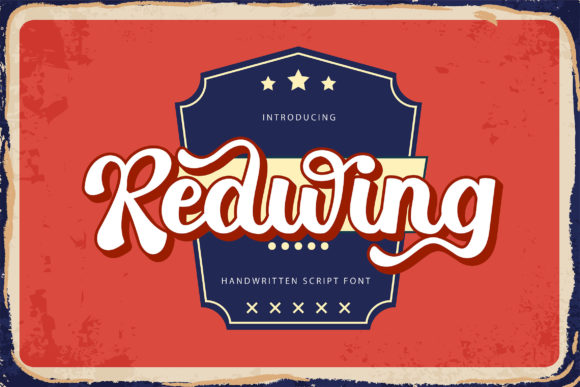
Redwing lands right where warmth meets polish: think vintage postcards reimagined with clean lines and confident curves. Its retro styling isn’t costumed—it’s lived-in, like ink slightly softened by time, but with crisp enough contrast and generous x-height to hold up beautifully at small sizes. That balance makes Redwing especially useful when you’re designing physical products—not just digital mockups. Whether you're cutting vinyl for boutique tags, printing on kraft sticker paper, or layering text over textured watercolor backgrounds in Canva, Redwing reads clearly without sacrificing personality.
For handmade sellers, readability isn’t optional—it’s part of your product’s trust factor. A customer scanning your soap label at market needs to instantly recognize your brand name and scent title. Redwing delivers that clarity even at 14–16pt on a 2" x 3" hang tag. Its open counters and consistent stroke weight prevent visual “clumping” during Cricut or Silhouette cuts, and its PUA encoding means every swash, alternate lowercase, and decorative capital is one click away—not buried in glyph panels or lost in outdated font managers.
I use Redwing across my own shop’s seasonal lineup: as the hero font on farmhouse-style welcome signs (paired with a warm, low-contrast sans like Montserrat Light), as delicate script accents on printable planner stickers, and as the sole typographic voice on minimalist greeting cards where less truly is more. It shines brightest in short-form applications—product names, monograms, event titles, boutique tags—but also holds its own in longer phrases like “Hand-poured in Small Batches” or “Est. 2021” when set with intentional spacing.
Here’s where Redwing becomes a quiet workhorse: packaging design. On matte-finish candle jars, its subtle bounce adds approachability without looking childish. On linen gift tags, it softens the formality of serif body text while keeping elegance intact. For holiday collections, I layer Redwing’s swashes into SVG files for layered paper ornaments—its natural flow translates seamlessly to cut lines, and the alternates let me avoid repetition across dozens of designs.
It’s also become my go-to for wedding stationery clients who want something timeless but not traditional. Redwing’s lowercase “g” and “y” have just enough flair to feel special, while its uppercase letters sit confidently on signage—no awkward floating ascenders or cramped descenders. When printed on cotton rag paper for save-the-dates, it gains texture; when laser-cut from birch plywood for escort cards, it retains legibility even with slight charring along edges.
Font pairing is where Redwing really earns its place in your Script Amp toolkit. I almost always pair it with a neutral sans serif—something airy and unobtrusive like Lato or Nunito—for body copy, ingredient lists, or care instructions. That contrast gives hierarchy without competition. For printables like wall art or quote cards, I’ll sometimes set Redwing alongside a gentle serif like Playfair Display—just enough structure to ground the script without dulling its charm. Avoid pairing it with other high-contrast scripts or overly decorative fonts; Redwing doesn’t need backup singers—it’s the lead voice, clear and confident.
Because Redwing is PUA encoded, accessing alternates is straightforward in design apps that support OpenType features—no need to hunt through character maps or install separate style files. That matters when you’re batch-producing 50+ sticker variations for an Etsy launch or prepping SVG bundles for digital download buyers. You get consistency *and* variation, all from one well-organized font file.
Practically speaking, Redwing works across formats: TTF and OTF files mean compatibility with Cricut Design Space, Silhouette Studio, Adobe Creative Cloud, Affinity apps, and even free tools like Photopea. While it’s not a multilingual font with extended Latin or Cyrillic support, its core character set covers English, French, Spanish, German, and Dutch diacritics—enough for most small-batch labels, invitations, and social media graphics aimed at North American and EU markets.
One thing I always double-check before listing a new printable or template? Licensing. Redwing is a commercial font, meaning you’re fully cleared to use it in physical products (mugs, tote bags, pressed-flower frames), digital downloads (PDF planners, Canva templates), SVG cut files, and client projects—as long as you’re not reselling the font file itself. That peace of mind lets me focus on design, not legal footnotes.
Whether you're pressing Redwing into clay for custom stamp sets, using it to label hand-dyed yarn skeins, or building a cohesive brand identity across Instagram posts and product tags—this script font bridges aesthetic intention and production reality. It doesn’t shout. It invites. And in a crowded handmade marketplace, that kind of quiet confidence is exactly what helps your work stand out—not blend in.
Redwing isn’t about nostalgia for its own sake. It’s about giving your handmade goods a voice that feels both familiar and freshly yours.